Tesla's Roadster flew for a few seconds. Its latest filing shows where the money is going
Tesla unveiled a Roadster that hopped, flipped and landed using rocket-company thrusters. We read the latest 10-Q to see what the show sits on top of.
On Thursday night, at a SpaceX test site in Texas, a sports car with no one inside drove up a ramp that curled over like a wave, clung to it upside down, and then let go. Thrusters pushed it off the end. It flipped in the air and landed on its wheels.
"Flying cars are real," Elon Musk told the crowd, CBS News reported. He added, in the same breath, that the car's "success is not guaranteed."
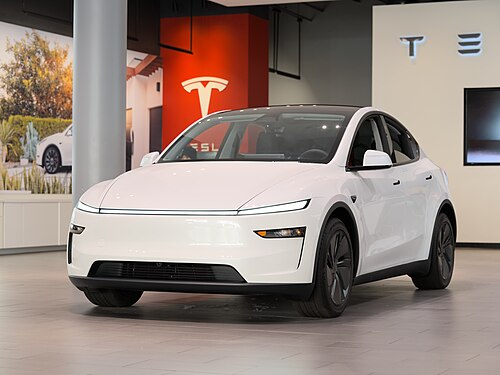
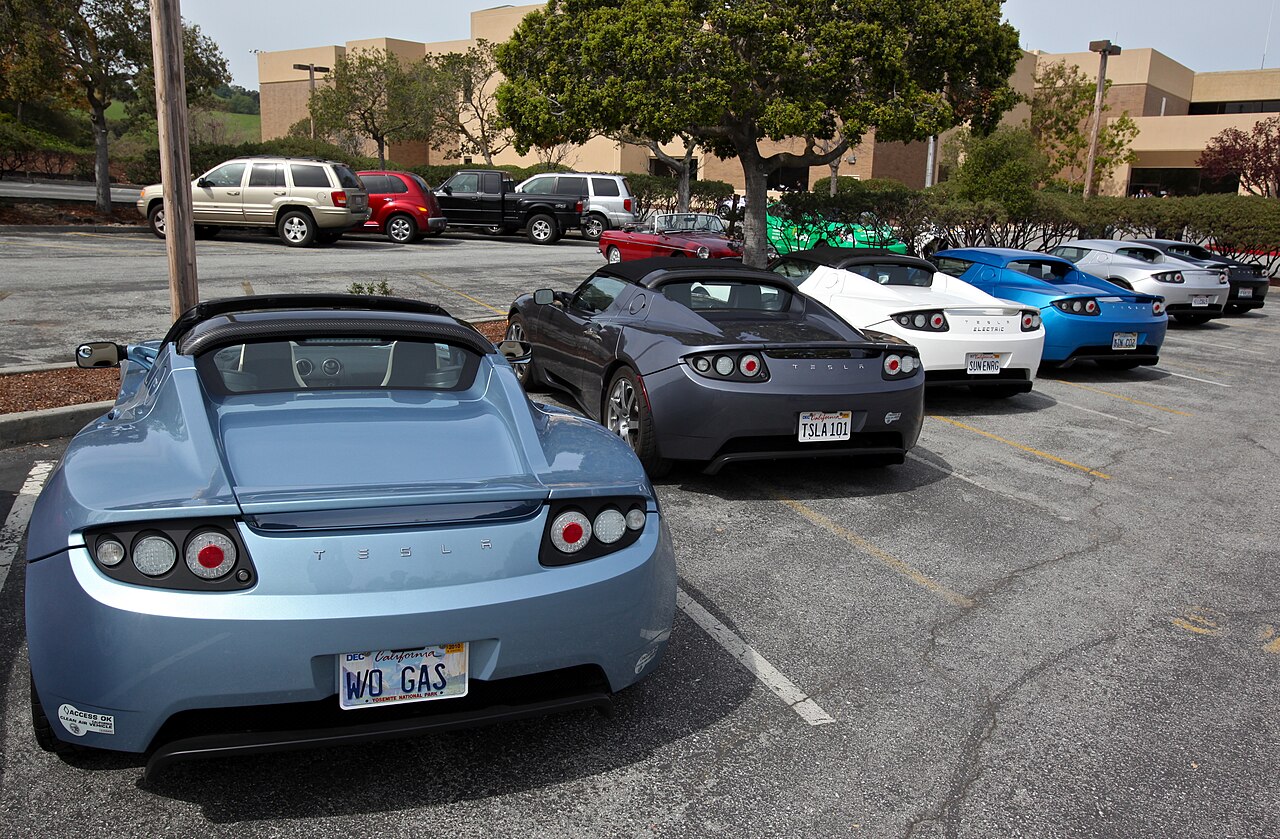
The car was a new Tesla Roadster. Tesla says it will go into production in 2028. It has not said what it will cost, and reports disagree on what a reservation costs now. Behind the show sits a company whose numbers look very different from the stage: sales are growing, the margin on them is shrinking, and the spending plans have just gone up.
What actually happened
The demonstration, livestreamed on X, had three parts, according to CNN, CBS News and Fox Business. The Roadster climbed the ramp with the help of a suction system under the car, flew off the end and rolled over to land on its wheels. It used the same air jets to leap over a line of parked Teslas. And it reached 60 mph in under a second.
There was no driver. That was "to make sure we don't kill anyone," Musk told the crowd, CNN reported. The car has 10 nozzles and what Musk called "ultra high-pressure air tanks." He described the result as what happens "when you have a collaboration with the world's best car company and the world's best rocket company."
Whether this is flying is another matter. Roger Connor, who curates vertical flight at the Smithsonian's National Air and Space Museum, told CNN before the event that anything between a car and an aircraft would be "a poor performing aircraft and a poor performing vehicle, and also quite expensive." Afterward, CNN noted that the demonstration included nothing like long-range flight. Connor's summary: "We're not talking about sustained flight," he said. "We are literally talking about hopping."
Regulators have not signed on. CBS News reported that the Federal Aviation Administration told it the vehicle doesn't meet the agency's definition of an aircraft, and that Tesla's own website says the planned flying model is not approved for public road use. CNN added that Musk has often promised dates and missed them by years.
Some basics are unsettled. CBS News reports a $5,000 deposit to reserve a non-flying Roadster. Fox Business reports that Tesla's reservation page listed $50,000 for a "Performance" version and $250,000 for a "Thrust" version. The two reports can't both describe the same offer, and we don't know which is right.
What the latest filing says
The demo came days before Tesla's third-quarter report, which analyst Dan Ives, as CBS News identifies him, put at October 21 in a research note. The latest numbers on file are the second quarter's, from the 10-Q Tesla filed on July 23. The Roadster is not in it. The words "Roadster," "flying" and "thruster" do not appear anywhere in the document. What does appear is a company changing its shape.
Revenue was $28.24 billion in the quarter, $5.74 billion more than a year earlier. Tesla says automotive sales revenue rose $4.22 billion, or 27%, on cash deliveries up approximately 25%. Services and other revenue rose $1.54 billion, or 50%. Energy storage revenue rose $350 million, or 13%, but its gross margin fell from 30.3% to 20.4%.
The profit did not follow. Operating income fell by more than half from a year earlier. Research and development spending rose $782 million, or 49%, and selling and administrative costs rose $616 million, or 45%. Of that second increase, $283 million was stock-based pay that Tesla ties mainly to the 2025 CEO Performance Award.
Net income was $1.11 billion, which is $58 million lower than a year earlier. That figure is propped up by an item outside the car and energy businesses: a $1.00 billion net gain on Tesla's shares in SpaceX, almost as large as the whole quarter's net income.
Tesla says plainly that it is choosing lower profit for now. In the 10-Q: "We are also investing heavily in research and development to accelerate our AI, software and fleet-based profits for further revenue growth, which will negatively impact our profitability during this phase."
The SpaceX thread
The Roadster's thrusters were developed with SpaceX, according to Fox Business, and the 10-Q shows how deep the link already runs.
In January, Tesla's 10-K for 2025 said it had agreed to invest approximately $2 billion in the artificial intelligence company xAI. The 10-Q says the money went in during March 2026 and became $2.00 billion of SpaceX common stock, "formerly a preferred share investment in xAI," a stake of less than 1%. Because Musk is chief executive of both companies, Tesla says it is presumed to have significant influence over SpaceX, and it records the shares at fair value.
The companies are also customers. Tesla recognized $318 million of revenue in the quarter from SpaceX's purchases of Megapack batteries, roughly a tenth of its energy revenue. Tesla calls those purchases ordinary-course business.
Bloomberg called the Roadster launch a "merger hint." Ives said the vehicle "puts the Tesla and SpaceX relationship on the table in a tangible way." Tesla has made no merger announcement, and neither of its two latest filings uses the word.
Where the money is going
The clearest line in the 10-Q is about spending. In the first half of the year, Tesla's capital spending (cash paid for property and equipment) was $8.28 billion, against $3.89 billion a year earlier. Operating cash flow was $8.63 billion, against $4.70 billion. Spending has nearly caught up with the cash the business throws off.
The company has also raised its forecast. The 10-K said in January that Tesla expected capital spending "in excess of $20 billion" this year. The 10-Q says: "We currently expect our capital expenditures to be in excess of $25 billion in 2026." The spending is driven, Tesla says, by AI projects including computing infrastructure and data centers, expansion of manufacturing lines, and growth in a fleet of company-operated assets that run on AI. For comparison, Tesla spent $8.53 billion in all of 2025. The 10-Q also says Tesla began production of Cybercab, its self-driving taxi, in the first half of the year.
Our read
Analysis. The Roadster will not decide how this year goes for Tesla. Ives, in a research note, said it "will not move the volume or revenue needle," and the 10-Q mentions it nowhere. Its job, as we read it, is to remind people of what the brand can do while the quarter's numbers say something less exciting: sales are growing again, profit per sale is shrinking, and the company is betting on AI, robots and a self-driving taxi.
The demo is also a message about Tesla and SpaceX. It used SpaceX hardware, at a SpaceX site, with Musk on stage as the head of both. A merger would be an enormous step and no filing says one is coming, so treat that as a guess. But the 10-Q's related-party note already shows shared investment, shared customers and a shared chief executive.
On the numbers, the arithmetic is worth doing. If Tesla spends more than $25 billion this year and spent $8.28 billion in the first half, it plans to spend more than twice as much in the second half as in the first. Operating cash flow would have to roughly double as well to keep up. If it doesn't, expect free cash flow to turn clearly negative when the third-quarter report arrives. Signs that would prove this wrong: spending that comes in below the forecast (the company's wording is a floor, not a promise), or a one-off jump in operating cash.
As for the flying part, take the demo for what it was. Flipping off a ramp is not the same as flying from one place to another. The test of the claim will come when someone other than the company shows a car moving through the air for more than a few seconds, with a person in it.
Also in the filings, October 12–16, 2026
- Insider buying $1.2M — 5 insiders at 5 companies
- Insider selling $58.2M — 20 insiders at 17 companies
- Covered companies reporting 38 — AA, ACI, ACN, BAC, BLK, BNY
- Theme: China +106% — mentions per 8-K vs the usual week
- Largest insider purchaseScully William P bought $920K of Prothena Corp Public Ltd Co (PRTA)
- Largest insider saleRothblatt Martine A sold $20.7M of UNITED THERAPEUTICS Corp (UTHR) under a trading plan
- Results filedDomino's, Marsh McLennan, Accenture, Commercial Metals, Travelers Companies
- Biggest jump in attentionTrump Media & Technology Group: Wikipedia views up 388% on the usual week
Sources
- Tesla unveils what it says is a flying car, called the Roadster · CNN
- With Tesla Roadster debut, Elon Musk shows "flying cars are real" · CBS News
- Tesla's new Roadster makes a flying debut, hitting 60 MPH in under a second · Fox Business
- Tesla Launches Roadster at SpaceX Site in Latest Merger Hint · Bloomberg
- Tesla Form 10-Q for the quarter ended June 30, 2026 · Tesla (SEC filing)
- Tesla Form 10-K for 2025 · Tesla (SEC filing)
This story describes figures the company has published. It is for information only and is not investment advice or a recommendation to buy, sell or hold any security. Check the original filings before relying on any figure. Stoqly is not affiliated with the SEC.